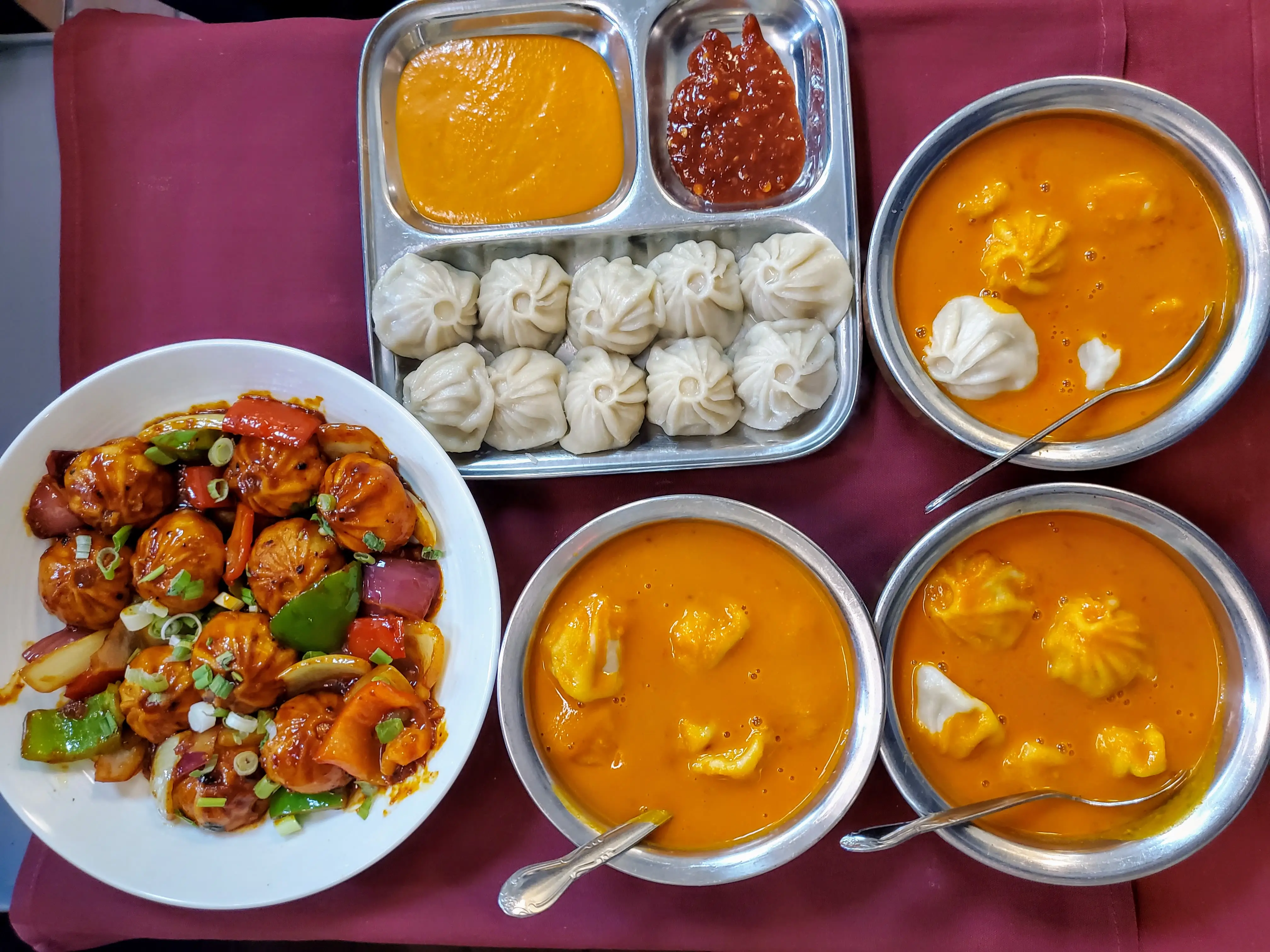
Momo has been a Himalayan staple for centuries. It’s only in the last few years that the rest of the world caught up.
Food trucks, TikTok, restaurant menus from Delhi to Dallas to Chicago — momo is suddenly everywhere. At Himalayan Restaurant, we’ve been making it the same way since 2003. Here’s where it actually comes from, how it conquered an entire subcontinent, why it’s catching on across America, and how we ended up shipping our own momo to grocery stores nationwide.
From Tibet to Nepal — and its own thing entirely
Momo’s roots trace back to Tibet, carried into Nepal by Newar traders from the Kathmandu Valley, generations before anyone called it street food. Nepal made it its own: the original Tibetan version is simple, seasoned mostly with salt, while Nepali cooks built in ginger, garlic, cumin, coriander, and timur — turning a plain dumpling into something distinctly Himalayan. It’s not just a Nepali jiaozi or gyoza, either — the dough is rolled thinner, the pleating is its own tradition, and the achar dipping sauce that comes with it is as essential as the dumpling itself. That’s the version we grew up on, and the version we serve.
Want the deeper dive? We wrote about the history and a full recipe here, and about what momo really means to us.
How momo took over India
The explosion happened somewhere it wasn’t even originally from — and it had two drivers, not one.
In 1959, the Dalai Lama and roughly 80,000 Tibetans fled into India, bringing their momo recipes with them; Tibetan settlements took root in cities like Kolkata, where refugee families began selling steamed momo from their homes. Alongside that, decades of ordinary Nepali labor migration — flowing into India through an open border formalized in 1950 — sent generations of workers into those same cities: Delhi, Mumbai, Kolkata. Wherever they settled and ate, Nepali food followed.
By the 1990s and 2000s, momo had spread through Delhi and Kolkata’s street food scenes for good. Today it’s one of India’s most popular street foods, sold on nearly every corner and endlessly localized — tandoori, Afghani, cheese-stuffed — almost entirely through people moving and working, not marketing.
Momo’s American moment
The same pattern is playing out here, decades later. Nepali immigration to the U.S. has surged over the past two decades — nearly quintupling in New York City alone between 2010 and 2020, with Jackson Heights, Queens and Irving, Texas becoming major Nepali business hubs. Momo followed, and it didn’t stay inside the community: Jackson Heights’ momo scene has been profiled by the New York Times and turned into a “momo crawl” trend on TikTok, and fusion versions — momo burgers, momo pizza, even chocolate momo — are usually a sign a dish has gone fully mainstream.
We felt that shift ourselves this month. On August 15, we joined the First Ever Nepali Street Festival in Edgewater, hosted by Nepalese Aid. We brought steamed momo and chili momo, and both sold just as fast as each other — with plenty of non-Nepali festivalgoers trying momo and genuinely loving it. Sharing our food, and the culture behind it, with people discovering it fresh is exactly why we do this.
How we make ours
Steamed — the classic. Fried — crisped at the edges. Chili momo — tossed in a bold chili glaze. Soup (jhol) momo — served in a warm, spiced broth. Fillings run chicken (halal), paneer, or vegetable, with a vegan option, and every order comes with our house achar.
We didn’t stop at the restaurant — meet Himalayan Momo
Since 2020, Himalayan Restaurant has run its own frozen food line, Himalayan Momo, made by our own company, Nepaley, at our own facility. It ships nationwide into the frozen aisle at stores like Whole Foods, Jewel-Osco, Patel Brothers, and Woodman’s, plus Amazon and Instacart — four flavors, Chicken, Vegetable (Vegan), Paneer, and Beef, freezer to plate in minutes. Some hospitals and university cafeterias carry it too. Same idea as the restaurant: momo made right, made accessible — we just figured out how to get it further than our own dining rooms.
Find Himalayan Momo near you at nepaley.com
Come taste it at the restaurant
Craving something more substantial than festival food? Our South Loop location on Wabash Ave is a short walk from Grant Park. Heading to Niles instead? Order a full momo platter and make it a family meal.
Order Himalayan Chicago | Order Himalayan Niles
Momo may be having a moment online. Nepal — and our kitchen — never stopped having it.